
Don’t waste water yet
Welcome rainfall did not have big impact on Vaal Dam levels
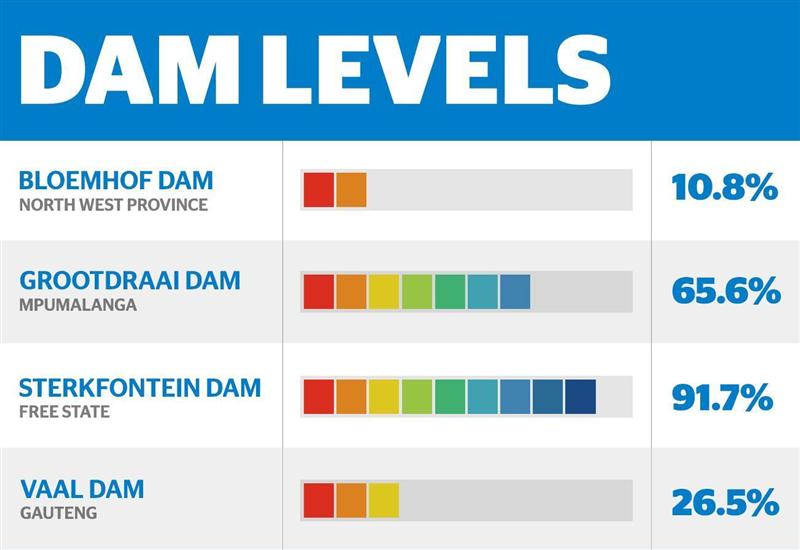
With the heavy rains, storms and flash-floods we’ve seen across Gauteng during the past few days, residents might think the looming water crisis is over and start using water recklessly.
But, despite the welcome rain, the Vaal Dam levels remain critically low at 26,5 per cent, and residents are urged to continue saving and conserving water, and not waste it unnecessarily.
According to the South African Weather Service’s (SAWS) climate stats, the Ekhurhuleni flooding was a 1 in 200 year event. The amount of rainfall measured was 79,4 mm in one hour, with a total of 89,6mm in 3 hours. Although the rain was very welcome, it did not have a huge impact on the levels of the Vaal Dam, which remain critically low.
“How is that possible?” you may ask. This is because rainfall, like buying property, is all about location.
The Vaal Dam is filled by the Wilge River (which runs through the Eastern Free State) and the Vaal River (which runs through Mpumalanga), and the catchment areas include the western parts of Mpumalanga (including Standerton, Ermelo, Secunda, and Villiers) and the western parts of the Free State (including Harrismith, Bethlehem, and Frankfort). In essence, this means that, for the Vaal Dam’s level to increase, we need rain in these areas. Rain in the Gauteng area, including the Vaal, flows downstream to the Bloemhof Dam.
The map below shows the Vaal Dam catchment area – the area outlined in green.
See below map of Vaal Dam catchment area – rain in green-bounded area feed the Vaal Dam. #SaveWater #WaterRestrictions pic.twitter.com/Laa0eIfDsl
— Rand Water (@Rand_Water) November 10, 2016
One way to measure how much rainfall was received is by using a rain meter, but not everyone knows exactly how they work.
One millimetre of rain is equal to one litre of water per square metre. So, if you receive 25 millimetres of rain on your 1 000 square metre property, 25 tonnes of water would have fallen. If you have a 1 000 hectare farm and receive 80 millimetres of rain, that would convert to 800 000 tonnes of water.
Using a 10 tonne water-truck to transport 10 loads of that water every day of the year (800 000/10/10/356), it would take up to 21,9 years to transport it all.
Also Read:
Can the City handle extreme weather conditions?
Six day forecast: Thunder storms ahead


