
Inside the unpredictable life of a medic
The Northsider journalist jumped into one of the QRS fleets on 16 November as part of a ride-along experience to learn more about the sector.
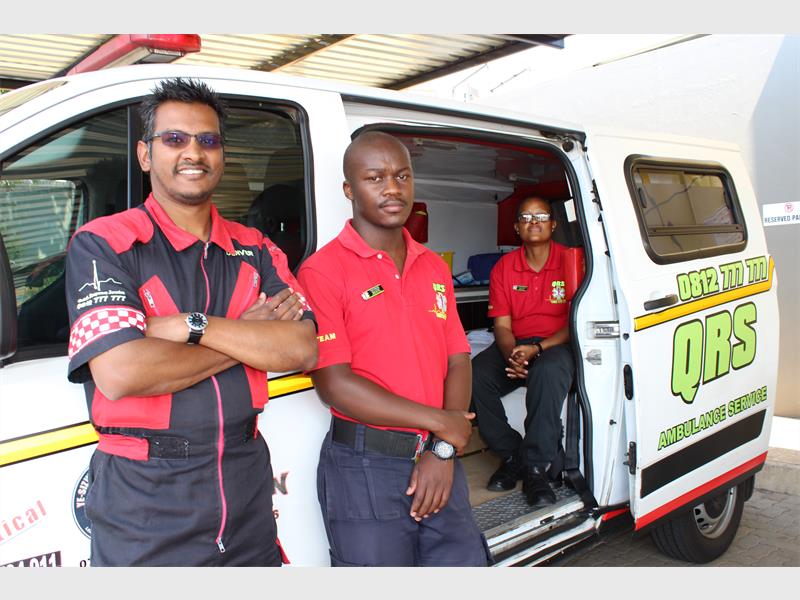

If they aren’t cutting through insane traffic with red lights flashing, in vehicles sounding noisy sirens, they are probably stationed in certain areas waiting for a call to attend to an emergency.
That is a life of a paramedic, a professional without a normal, predictable job. A paramedic’s shift can consist of 12 hours of doing nothing, or sheer chaos filled with risks and gory scenes.

Quick Response Service (QRS), a local ambulance company, is one of many emergency services living this testimony.
The Northsider journalist jumped into one of QRS’ vehicles on 16 November, as part of a ride-along experience, to learn more about the industry.
Denver Ramnarain, the founder and director of the company, who has saved many lives, shared what drove him to start his own company.

“I used to work for a private ambulance service, but in 2009, I transferred to the state services when government was recruiting paramedics while gearing up for the 2010 Soccer World Cup.
“During the next three years, I thought I would make the government sector the best, as I was passionate about the industry and eager to implement change,” Denver explained. However, things did not turn out as planned, he said. “Government sectors are quite resistant to change.”
WATCH HERE
And so, in 2012, QRS was born. “When I felt my passion beginning to dwindle, I left the state to start the company. My idea was to help people, provide the best service for patients, and be able to pay all my bills,” he explained.
Competition may seem tough in the sector, as ambulance services race every day to be first at the scene, since providing a service to a patient secures a sale for them. However, for Denver this is not the case, as the competition goes far beyond the chase for a patient pick-up. “In this sector, competition occurs on several levels, mainly management, ownership and medical aid. If you’re on that level, you are big, like Netcare 911 and ER24 (companies with which he works very closely),” he said.

While en route to the home of a cancer patient in urgent need of medical care in Krugersdorp, Denver spoke about dealing with patients and what it’s like when they die in their hands. “I’ve seen people on the verge of death and resuscitated them back to life, and I’ve seen others who’d be talking to me one minute, and then die, right in front of my eyes,” he reflected.
“You have to learn to take the good with the bad – there’s going to be days when you put in 100 per cent effort and it’s fruitless, and others when you do the minimum for the patients, and they flourish. There are so many aspects to patient deaths, especially with cancer patients, because if they are terminal, they have the right to refuse resuscitation, and you need to respect their wishes.”
Two QRS paramedics, Phindile Khumalo and Terello Sebaeng, told our journalist about dealing with traumatic experiences, saying that they debrief one another by talking about the incident and focusing on the positive, which is saving lives.
As we manoeuvred through traffic, heading towards the patient, Denver talked about driving an ambulance. “In this industry, there is no legislation that paramedics must have certain driving skills. However, the drivers have to have driver’s licences for the appropriate code of vehicle, and a PDP, which allows them to transport patients.
“When you hire a student fresh from college, you trust him (or her) with the vehicle after providing site training, during which you teach them how to drive fast, deal with traffic and avoid accidents,” he explained, adding that the industry has textbooks that teach medics about responding and defensive driving.

QRS has had its fair share of accidents that have turned its medics into patients. “Sometimes we end up in accidents that are on us, or the fault of another motorist, but we deal with each situation separately,” Denver explained.
He added that these accidents leave a void in their operations. “In 2015, when we had two accidents, we were contemplating closing down, because there was no way we could have operated without a vehicle. Accidents cost you insurance claims, down-time and salaries,” he lamented.
He said further that if paramedics feel unsafe at a scene, he does not hesitate to cancel the call-out, solely to avoid any danger.
Denver said that over the years, they’ve dealt with most of the challenges, and have employed more staff to improve their operations.
Do you perhaps have more information pertaining to this story? Email us at northsider@caxton.co.za (remember to include your contact details) or phone us on 011 955 1130.
For free daily local news on the West Rand, also visit our sister newspaper websites


