
Today in History: Neptune is discovered
It was officially discovered after a French astronomer calculated its approximate location.
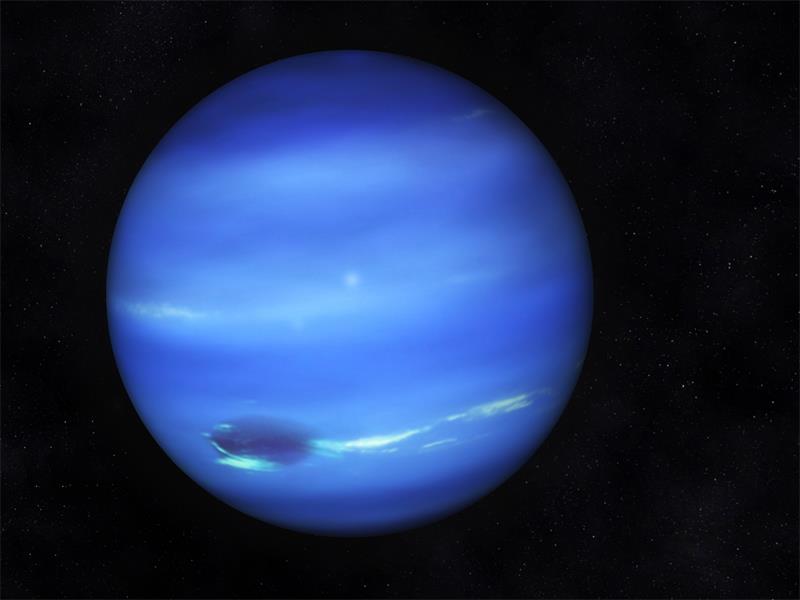

German astronomer Johann Gottfried Galle discovered the planet Neptune at the Berlin Observatory on this day in 1846.
Neptune, the eighth planet from the sun, was postulated by the French astronomer Urbain-Jean-Joseph Le Verrier, who calculated the approximate location of the planet by studying gravity-induced disturbances in the motions of Uranus. On 23 September 1846, Le Verrier informed Galle of his findings, and the same night Galle and his assistant Heinrich Louis d’Arrest identified Neptune at their observatory in Berlin.
Noting its movement relative to background stars over 24 hours confirmed that it was a planet. The blue gas giant, which has a diameter four times that of Earth, was named for the Roman god of the sea.
It has eight known moons, of which Triton is the largest, and a ring system containing three bright and two dim rings. It completes an orbit of the sun once every 165 years. In 1989, the US planetary spacecraft, Voyager 2, became the first human spacecraft to visit Neptune.
Do you perhaps have more information pertaining to this story? Email us at roodepoortrecord@caxton.co.za (remember to include your contact details) or phone us on 011 955 1130.
For free daily local news on the West Rand, also visit our sister newspaper websites
Remember to visit our Facebook, Twitter and Instagram pages to let your voice be heard!


