
Today in History: Battle of Kambula takes place during Anglo-Zulu War
By 11am on 29 March, rangers returned with news that the impi was on the move and was to attack Kambula at noon.
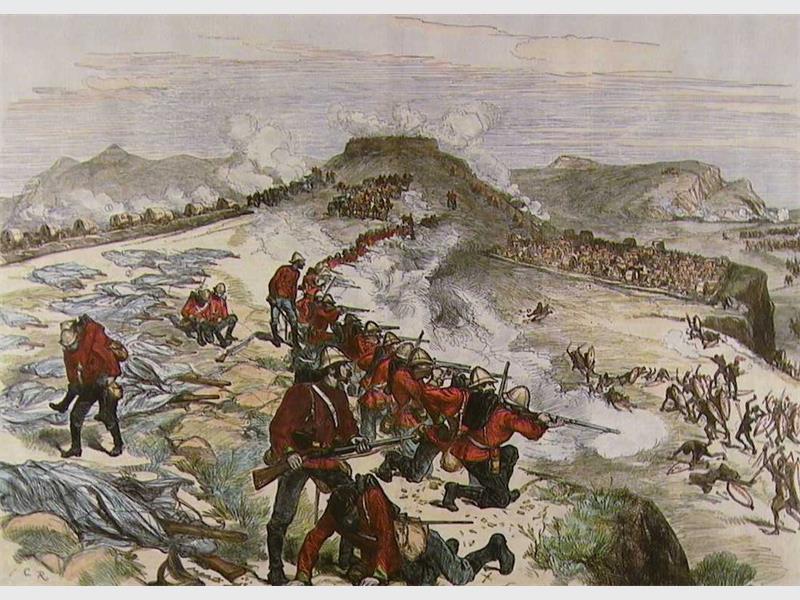

On this day in 1879, the Battle of Kambula took place when 20 000 Zulu warriors attacked a British camp, resulting in a decisive loss for the Zulu impi (army/ regiment).
Following the disaster at Hlobane on 28 March 1879, Colonel Evelyn Wood’s forces prepared for an attack by the entire Zulu impi, of which they had only previously encountered the leading sections. Soon after dawn of 29 March, rangers rode out to locate the enemy impi, the cattle were put out to graze and, after some deliberation, two companies were dispatched to collect firewood.

Wood also received information that the impi was nearly 20 000 men strong, consisting of regiments that had already defeated the British at Isandlwana and other battles, and that many of the Zulus were armed with rifles taken from the British dead at these battles. Shortly after this the Zulu impi was sighted five miles away across the plain, coming on due westwards in five columns. However, the warriors of the impi had not eaten for three days.
The woodcutters and cattle were brought back in and, confident that the defences could be manned within a minute and a half of an alarm being sounded, Wood ordered the men to have their dinners.
Zulu King Cetshwayo kaMpande responded to pleas from the abaQulasi for aid against the raids of Wood’s troops by ordering the main Zulu army to help them. He ordered it not to attack fortified positions but to lure the British troops into the open even if it had to march on the Transvaal to accomplish this. His orders were not followed.
The impi attacked Kambula shortly after noon, and things definitely did not go well for the Zulu warriors. An intense battle ensued between the British and Zulu forces, with the British defences ultimately able to repel the Zulu warriors. Two days after the battle, burial parties counted 785 Zulu dead in the immediate vicinity of the camp but their total losses were significantly higher as there were many more bodies further out from the camp.
By contrast to the heavy Zulu losses, only 18 British soldiers were killed, and eight officers and 57 men wounded, 11 of whom later died. Kambula is considered as the turning point of the war, for the British demonstrated that shield and assegai were no match for an entrenched force with artillery.
Information courtesy of: https://en.wikipedia.org/wiki/Battle_of_Kambula.


