
Today in History: First WWII kamikaze attacks struck Allied Forces
More than 5 000 kamikaze pilots died in the gulf battle-taking down 34 ships.
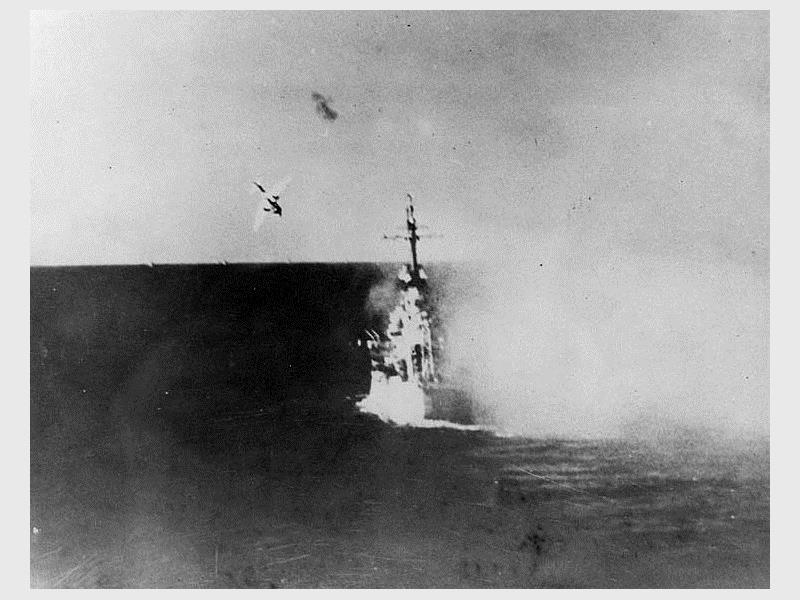

On this day in 1944, during the Battle of the Leyte Gulf, the Japanese deployed kamikaze (‘divine wind’) suicide bombers against American warships for the first time.
The decision to employ suicide bombers against the American fleet at Leyte, an island in the Philippines, was based on the failure of conventional naval and aerial engagements to stop the American offensive. Japanese naval Captain Motoharu Okamura declared: “I firmly believe that the only way to swing the war in our favour is to resort to crash-dive attacks with our planes … There will be more than enough volunteers for this chance to save our country.”
The first kamikaze force was composed of 24 volunteer pilots from Japan’s 201st Navy Air Group. The targets were US escort carriers; one, the St Lo, was struck by a A6M Zero fighter and sank in less than an hour, killing 100 Americans.
For their kamikaze raids, the Japanese employed both conventional aircraft and specially designed planes, called Ohka (‘cherry blossom’) by the Japanese, but Baka (‘fool’) by the Americans, who saw them as acts of desperation. The Ohka was a rocket-powered plane that was carried toward its target attached to the belly of a bomber.
All told, more than 1 321 Japanese aircraft crash-dived into Allied warships during the war in a desperate effort to reverse the growing Allied advantage in the Pacific. While approximately 3 000 Americans and Brits died because of these attacks, the damage done did not prevent the Allied capture of the Philippines, Iwo Jima, and Okinawa.
Do you perhaps have more information pertaining to this story? Email us at northsider@caxton.co.za (remember to include your contact details) or phone us on 011 955 1130.
For free daily local news on the West Rand, also visit our sister newspaper websites


