
Tempers flared throughout Johannesburg yesterday (9 December) after Stage 6 load-shedding was announced. While it only lasted a few hours, the anger, worry, and annoyance left its mark.
Load-shedding stays predominantly within the four initial stages, with six time slots.

Read the initial article here:
https://roodepoortrecord.co.za/2019/12/10/load-shedding-for-this-week/
The higher the stage, the more severe the load-shedding. To explain it in simple terms: as the stages go up, more power needs to be shed. For example, in Stage 4, 4000MW of electricity needs to be shed rotationally, and in Stage 8, that number goes up to 8000MW.
The need to increase load-shedding from four to eight stages arose in 2015. Eskom has said that load-shedding, while inconvenient, is necessary to prevent a nationwide blackout, but it is under control. “Load-shedding is a responsible act and a highly controlled process, implemented to protect the country from a national blackout.”

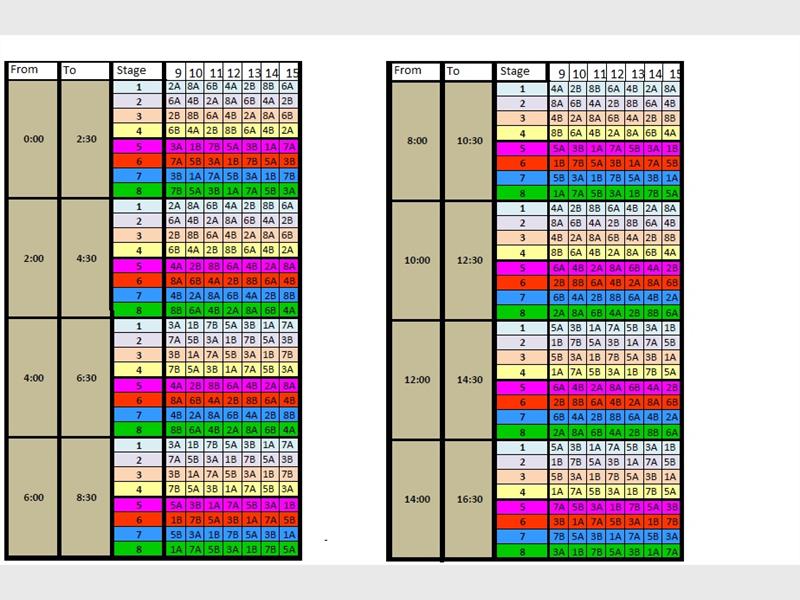
The 8-stage schedule was released shortly after the announcement, and here is how it works:
• If load-shedding is in the first four stages, you use the initial schedule with six time slots
• If load-shedding increases to Stage 5 and upwards, a new schedule with 12 time slots is used
• With the 8-stage schedule, slots are shortened to 2,5 hours, but the rotations are more regular (some residents may have load-shedding in up to seven of the 12 daily time slots)
The Record has shortened the monthly schedule to show the Stage 8 load shedding times for this week (9 to 15 December). Residents are reminded that the 8-stage schedule is only valid if load-shedding is in Stage 5, 6, 7, or 8, otherwise the initial schedule is valid.


