
Today in History: John Fairbairn celebrates South African press freedom
Three decades after obtaining the freedom of the press, Fairbairn was eventually able to help pass the bill in parliament to end libel restrictions.
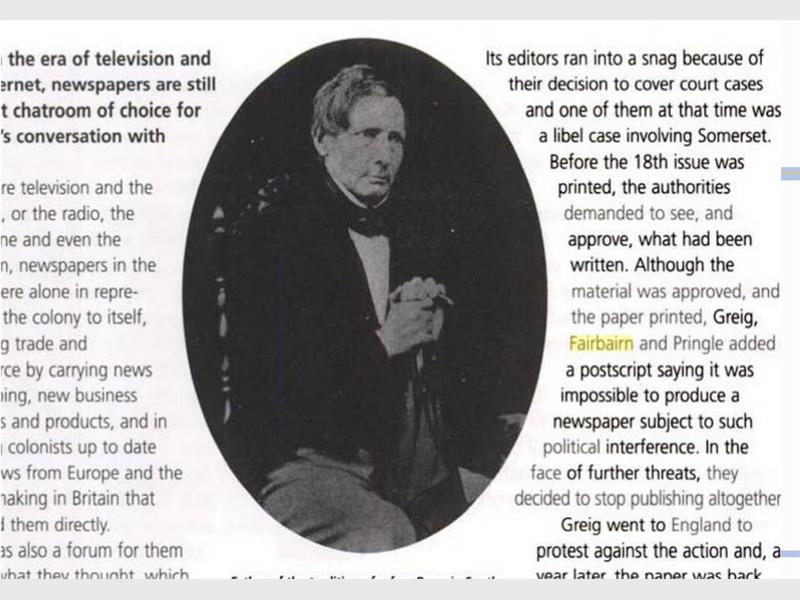
On this day in 1829, John Fairbairn, a British newspaper proprietor, educator, financier and politician in the Cape Colony, celebrated the promulgation of the freedom of the press in South Africa.
Fairbairn arrived in Table Bay on 11 October, 1823, aboard the brig Mary. At the time, the Cape was under the authoritarian control of the British Governor, Lord Charles Somerset. Both the school and the scientific society which he and Thomas Pringle tried to establish were obstructed and shut down in 1824–1825, because of the Governor’s disapproval of their activities.
Pringle then turned to editing, and in 1824, he and Fairbairn founded a periodical named the South African Journal, but the Governor closed it in the same year. They then founded another periodical, the New Organ, in 1826, but it immediately suffered the same fate.
Fairbairn and Pringle’s most successful media venture came in the form of The South African Commercial Advertiser, South Africa’s first independent newspaper, which was first published in Cape Town on 7 January, 1824. It was banned between 5 May, 1824 and 31 August, 1825, and between 10 March, 1827 and 3 October, 1828, again by order of Lord Somerset.
Fed up with the ongoing issues, Fairbairn travelled to London in 1827 to seek justice. He was given permission to open the newspaper again, but only if he avoided all controversy regarding politics or public persons.
In April 1829, six months after the Advertiser reopened, the press was given freedom from the Governor’s control, but was still bound by strong libel rules.
Sources differ as to the actual date on which the ordinance proclaiming press freedom was passed, with one stating that it occurred on 8 May, 1829, and two others stating that it was promulgated on 29 April, 1829, and took effect on 15 May.
Fairbairn, who fought to have this ordinance passed, even though it had limitations, has however remained one of the honoured names in the history of press freedom in our country.
Information courtesy of: https://en.wikipedia.org/wiki/The_South_African_Commercial_Advertiser, https://en.wikipedia.org/wiki/John_Fairbairn_(educator), https://books.google.co.za/books?id=57gyw36xwk8C&pg=PA80&dq=John+Fairbairn&hl=en&sa=X&ei=kkpaU5D_EI7g7QaejoCgDA&ved=0CEsQ6AEwBQ#v=onepage&q=John%20Fairbairn&f=false, and https://www.sahistory.org.za/dated-event/freedom-press-established-cape.


