
Today in History: Alexander Graham Bell patents the telephone
With the help of Thomas Watson, a Boston machine shop employee, Bell developed the prototype.
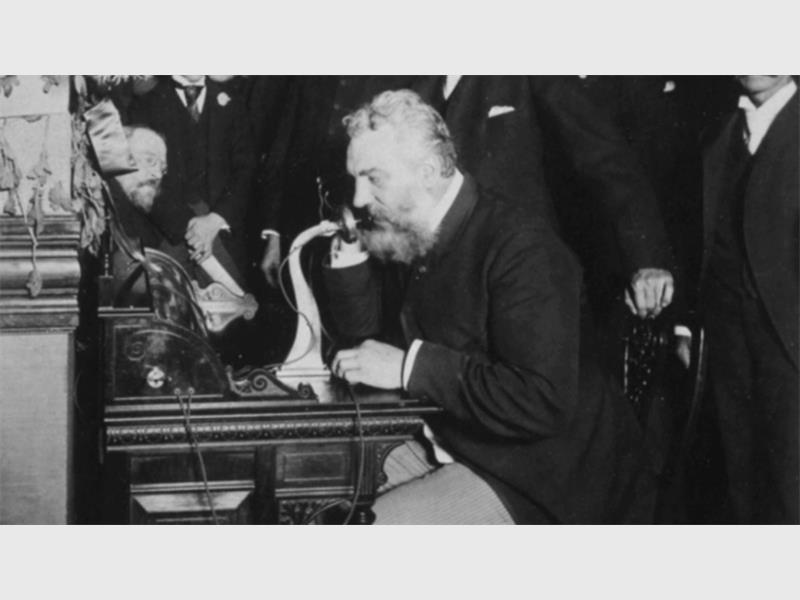
On this day in 1876, 29-year-old Alexander Graham Bell received a patent for his revolutionary new invention – the telephone.
The Scottish-born Alexander worked in London with his father, Melville, who developed Visible Speech, a written system used to teach speaking to the deaf. In the 1870s, the Bells moved to Boston, Massachusetts, where Alexander found work as a teacher at the Pemberton Avenue School for the Deaf.
While in Boston, he became very interested in the possibility of transmitting speech over wires. Samuel FB Morse’s invention of the telegraph in 1843 had made nearly instantaneous communication possible between two distant points. The drawback of the telegraph, however, was that it still required hand-delivery of messages between telegraph stations and recipients, and only one message could be transmitted at a time.
Alexander wanted to improve on this by creating a “harmonic telegraph”, a device that combined aspects of the telegraph and record player to allow individuals to speak to each other at a distance.
In this first telephone, sound waves caused an electric current to vary in intensity and frequency, causing a thin, soft iron plate – called the diaphragm – to vibrate. These vibrations were transferred magnetically to another wire connected to a diaphragm in another, distant instrument.
When that diaphragm vibrated, the original sound would be replicated in the ear of the receiving instrument. Three days after filing the patent, the telephone carried its first intelligible message – the famous “Mr Watson, come here, I need you” – from Alexander to his assistant.
Information courtesy of: https://www.history.com/this-day-in-history/alexander-graham-bell-patents-the-telephone.


