
#WestWitsMine Setting the record straight
The number of vehicle trips would have an insignificant contribution to an increase of congestion
It is not the responsibility of a private mining company to deal with or close down zama-zama operations; the Department of Mineral Resources (DMR) is directly responsible for dealing with illegal miners
This is according to Robyn Mellett from Hulme Scholes Consulting who said, “The additional directive from DMR is to remediate the situation. The community always wanted the area to be cleaned up and rehabilitated, and this is what we are currently doing. West Wits is continuously cleaning up and rehabilitating the area as remediation is under way. The positive consequence is to ultimately remove access points for illegal miners, reduce dumping and prevent the illegal occupation of land.”
Also Read:
https://roodepoortrecord.co.za/2018/08/20/westwitsmine-dust-is-not-settling-yet/
The most pressing questions that were asked at the West Wits public open day events, according to Elemental-S, related to labour and social concerns, and what the impact of dust, vibrations and noise will be on the area’s residents.
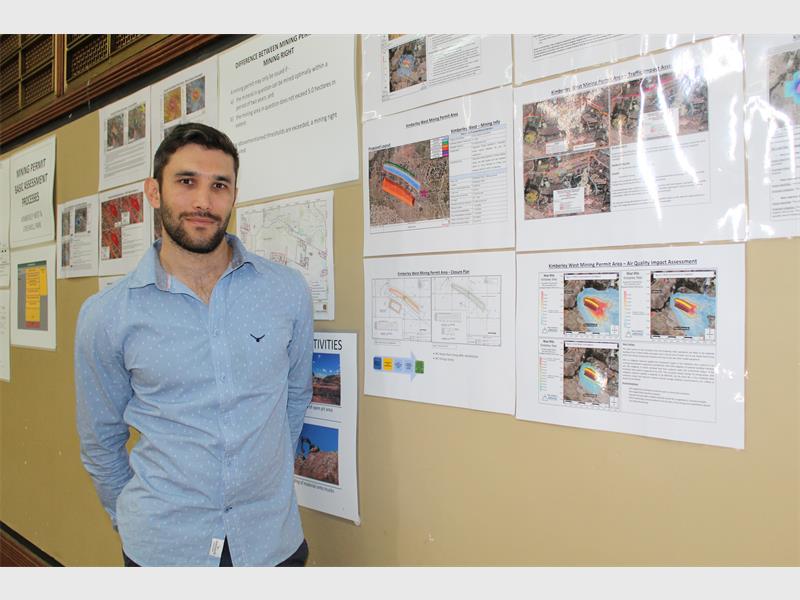
Du Toit Wilken from Elemental-S, and independent environmental impact practitioner employed for the basic assessments process with reference to the West Wits mining permits answered the resident’s most pressing questions during the day.
He said an external company has been employed to investigate the levels of dust and noise that will emanate. “The main sources of dust emissions are likely to be materials handling of the run of mine (ROM) and waste rock in the pit as well as vehicle entrainment emissions from haul trucks and other equipment. With no mitigation measures, the applied incremental impact is expected to be medium. However, with 50 per cent mitigation of material handling emissions and 30 per cent mitigation of vehicle entrained dust from unpaved roads, the impact is expected to be low to an almost zero toxic dust emissions.”
He explained that the different reefs contains different toxic gasses such as arsenic, which is needed to dissolve gold. “Noise levels at the Kimberley West area are minimum because we are not operating at night and with mitigating measures taken, noise levels are reduced significantly. The assessment, done by a traffic engineer, concluded that only 19 trips by heavy vehicles will be done every day for the next five months.”
Hulme Scholes Consulting reiterated that there is no relation between West Wits and Mintails and explained that these are two separate organisations with no similarities now, or in the past. Eddie Milne, a former employee of Mintails, is currently working as a contractor for West Wits and he has successfully rehabilitated portions of the previously impacted area at Sol Plaatjes. Mintails went into business rescue recently.
“Another concern we want to deal with,” said Robyn Mellett from Malan Scholes Consulting, “is that exclusion zones are important, especially when blasting is the method used for opencast mining, as fly rock is a concern. Therefore an alternative mining method is proposed for the opencast mining and for this project, Xentric rippers are used and no blasting will be done.”
An independent specialist, Cambrian CC weighed in and said people are exposed to disturbances such as dust and cracked houses on a daily basis because it is a normal occurrence. When mining activities take place, people tend to respond emotionally to the disturbances related to the activity as these can be unusual and unexpected. “This frequently results in complaints and claims that damage has occurred, which is then attributed to mining. Vibration monitoring has been carried out at West Wits pit number three. The aim was to quantify the disturbance levels caused by the activity to determine if the levels were high enough to cause any damage to structures.
“The vibration levels attenuated rapidly with an increase in distance, which means that distances greater than 50m will be negligible in this environment and the ground vibrations in close proximity to the equipment were not high enough to cause damage to structures. Residents can rest assured that the mining-related disturbances are not causing damage to their properties.”
Another concern the residents have is road congestion and the destruction of road infrastructure. According to Siyazi Gauteng Consulting Services, the anticipated number of vehicle trips to be generated by the proposed mining development would be about 16 light vehicles and 24 heavy vehicles per day, thus resulting in a total anticipated number of 40 vehicles trips. The traffic assessment, focusing on Randfontein Road, concluded that the intersection is already congested. Thus the number of vehicle trips would contribute insignificantly to an increase in congestion. “It is important to note that the mining development will take place in sequence.”
Do you perhaps have more information pertaining to this story? Email us at roodepoortrecord@caxton.co.za (remember to include your contact details) or phone us on 011 955 1130.
For free daily local news on the West Rand, also visit our sister newspaper websites
Remember to visit our Facebook, Twitter and Instagram pages to let your voice be heard!


