
Today in History: French soldier discovers the Rosetta Stone
The stone was seized from Napoleon Bonaparte by British forces after his defeat in 1801.
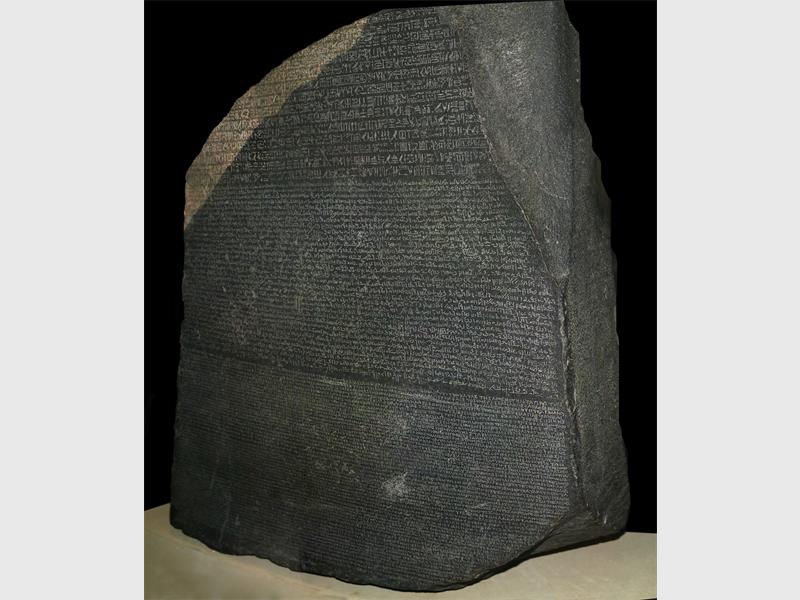

During Napoleon Bonaparte’s Egyptian campaign in 1799, a French soldier discovered a black basalt slab inscribed with ancient writing near the town of Rosetta, about 56km north of Alexandria.
The irregularly shaped stone, which would become known as the Rosetta Stone because of where it was found, contained fragments of passages written in three different scripts: Greek, Egyptian hieroglyphics and Egyptian demotic. The ancient Greek on the Rosetta Stone told archaeologists that it was inscribed by priests honouring the king of Egypt, Ptolemy V, in the second century BC.
Perhaps even more surprising, the Greek passage announced that the three scripts were all of identical meaning. The artefact thus held the key to solving the riddle of hieroglyphics, a written language that had been ‘dead’ for nearly 2 000 years.
When Napoleon, an emperor known for his enlightened view on education, art and culture, invaded Egypt in 1798, he took along a group of scholars and told them to seize all important cultural artefacts for France. Pierre Bouchard, one of Napoleon’s soldiers, was aware of this order when he found the basalt stone, which was almost 1,2m long and 0,8m wide, at a fort near Rosetta.
When the British defeated Napoleon in 1801, they took possession of the Rosetta Stone. Several scholars, including Englishman Thomas Young, made progress with the initial hieroglyphics analysis of the Rosetta Stone. French Egyptologist, Jean-Francois Champollion, who had taught himself ancient languages, ultimately cracked the code and deciphered the hieroglyphics using his knowledge of Greek as a guide.
Hieroglyphics used pictures to represent objects, sounds and groups of sounds. Once the Rosetta Stone inscriptions were translated, the language and culture of ancient Egypt was suddenly open to scientists as never before.
The Rosetta Stone has been housed at the British Museum in London since 1802, except for a brief period during World War I. At that time, museum officials moved it to a separate underground location, along with other irreplaceable items from the museum’s collection, to protect it from the threat of bombs.
Do you perhaps have more information pertaining to this story? Email us at roodepoortrecord@caxton.co.za (remember to include your contact details) or phone us on 011 955 1130.
For free daily local news on the West Rand, also visit our sister newspaper websites
Remember to visit our Facebook, Twitter and Instagram pages to let your voice be heard!


