
Legal mining to curb illegal mining
"Mining is already taking place in Solplaatjies without the necessary approval"- DA ward councillor, Gert Niemand
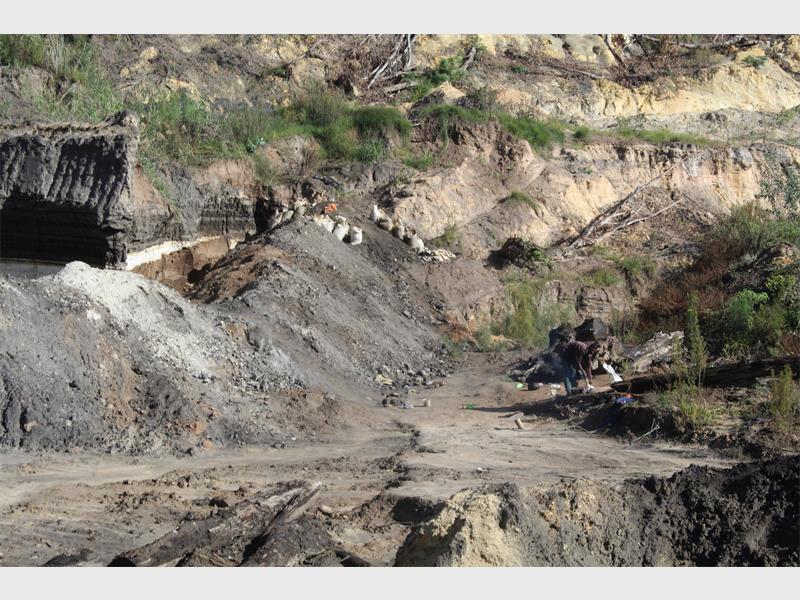
West Wits Mining not only aims to curb illegal mining, but also to refurbish the existing underground working in order to mine underground.
But, the proposed project would involve a combination of opencast mining and refurbishing of the existing underground shaft and infrastructure to conduct longer-term underground mining operations. According to Marline Medallie, an Environmental Assessment Practitioner from Synergistics, the whole purpose of the NEMA Directive for the Solplaatjies project is to stop illegal mining, by removing the easily accessible ore that the illegal miners exploit.
Also read: Residents say no to mining
“According to West Wits Mining, if this ore is removed and the underground access adits are concreted over, as is currently being done, illegal mining will stop. The property development, which is supported by the municipality, will also reduce illegal mining. The longer-term project anticipates mining activities which will drive out the illegal miners. As stated above, the NEMA Directive is supported by the police, who in fact want more such rehabilitation projects undertaken in the area to curb the illegal mining.

“Mining operations can not start without the required legislative approval. The scoping and environmental impact assessment process to inform decision-making on the right application as well as the mining permit applications are currently under way.”
Medallie said the 30-day consultation period is as per legislation. “The comments and requests will be raised and discussed with the Department of Mineral Resources (DMR). Interested and affected parties registered on the project’s database will be notified of the outcome of this discussion.”
She said the application processes for waste and water use licenses have been initiated and the power and water supply as well as waste management for the projects are being considered by the project team. “The relevant information will be included in the environmental assessment reports. Radiation, groundwater and several specialised assessments are still under way. The specialist study to evaluate the effect the noise of the blasting and crushing of rocks as well as the 16 to 24 working hours will have on the community is also still under way.”
Medallie said West Wits plans to employ 40 to 50 local workers for the opencast mining and 300 to 500 employees for the underground workings.
Bench Mark Foundation
But, David van Wyk, the lead researcher from Bench Mark Foundation, a non-profit faith-based organisation said mining operations have already started in Solplaatjies without prior consent. “A community meeting was held in Witpoortjie about two weeks ago and interested parties had to sign an attendance register. By signing the register they, in effect, gave consent for the mining operation to continue, unless they wrote ‘no consent given’ under their signature. The 30-day public consultation period is not enough for the community to understand the full impact and to object,” he said.
Also read: Community puts foot down against new mining project
Van Wyk said the mining operation will not only leave a huge environmental mess, but will also negatively affect property values. “Residents will see an escalation of crime and since many pensioners invested in property in that area, they are going to lose on a major scale. This does not include the health risks involved in mining uranium. The rainwater in the underground tunnels is acidic, businesses will suffer and the chances of having sinkholes and cracked houses are a big possibility.”
He said the DMR failed to regulate mining. “This should not be allowed because a huge opencast mine will be established right next to the Roodepoort CBD. At the moment, the community has no right to say “No”. DMR simply issued a license without an environmental impact assessment.”
Van Wyk said the mining will not improve the area, but make it worse. “Gold, uranium, silver, sandstone and aggregate will be mined. Dust- and water-filled uranium is in itself a huge health risk. Underground water will have to be pumped out before mining can continue. That water will filter back into system. We suspect that cerebral palsy and some types of cancer are linked to long-term exposure to uranium dust and water.”
DA councillor Gert Niemand
DA ward councillor, Gert Niemand, said the whole business was done very underhandedly. “Although they advertised the proposed mining area, I saw it by chance, and mining is already taking place in Solplaatjies without the necessary approval.
“Two more community meetings will take place on 10 and 15 May in the Davidsonville Recreation Centre and the Roodepoort Town Hall respectively.”
Uranium
South Africa has the second-largest reserves of uranium in the world. The Nuclear Fuels Corporation of South Africa (NUFCOR) started processing uranium as a by-product of gold mining in 1967. Many contemporary uses of uranium exploit its unique nuclear properties. Most of the uranium produced as a by-product of gold mining is concentrated in the gold fields of the Witwatersrand area. Uranium is more easily and readily available than gold in South Africa.
Though uranium production in South Africa showed a decrease from 711 tonnes in 2000 to 579 tonnes in 2010, in 2011 930 tonnes were produced with a forecast of 2 000 tonnes by 2020. In 2016, Tasman Pacific Minerals, owned by Peninsula Energy started plans to open the first uranium ore mine, Tasman RSA.
Health risks of uranium
Because uranium ore emits radon gas, uranium mining can be more dangerous than other underground mining, unless adequate ventilation systems are installed. During the 1950s, many Navajos in the US became uranium miners, as many uranium deposits were discovered on Navajo reservations. A statistically significant subset of these early miners later developed small cell carcinoma after exposure to uranium ore. Radon-222, a natural decay product of uranium, has been shown to be the cancer-causing agent.
Residues from processing of uranium ore can also be a source of radon. Radon resulting from the high radium content in uncovered dumps and tailing ponds can easily be released into the atmosphere.
It is also possible that ground and surface water will be contaminated with uranium by leaching processes. In July 2011, the World Health Organization (WHO) released the fourth edition of its guidelines for drinking-water quality. The drinking water guidance level for uranium was increased to 30?g L. This limit can be exceeded near mill tailings or mining sites.
In January 2008, Areva was nominated for an Anti Oscar Award. The French state-owned company mines uranium in northern Niger, where mine workers are not informed about health risks, and analysis shows radioactive contamination of air, water and soil. The local organisation that represents the mine workers, spoke of “suspicious deaths among the workers, caused by radioactive dust and contaminated groundwater.”

Who knew?
* Only 1,38 per cent of the uranium in the “Little Boy” bomb that destroyed Hiroshima underwent fission, according to the Atomic Heritage Foundation. The bomb contained about 140 pounds (64 kg) of uranium total.
* The “Little Boy” bomb detonated 1,670 feet (509 meters) above Hiroshima and left only the frames of a few reinforced concrete buildings standing within a mile radius around Ground Zero, according to a 1980 Defense Nuclear Agency report. Firestorms destroyed everything within a 4,4mile radius (7 kilometers) of the blast.
* The half-life of uranium-238 is 4,5 billion years. It decays into radium-226, which in turn decays into radon-222. Radon-222 becomes polonium-210, which finally decays into a stable nuclide, lead.
* Marie Curie, who worked with uranium to discover several even more radioactive elements (polonium and radium), probably succumbed to the radiation exposure involved in her work. She died in 1934 of aplastic anaemia, a red blood cell deficiency probably caused by radiation damage to her bone marrow.
* Pure uranium is a silvery metal that quickly oxidises in air.
* Uranium is sometimes used to colour glass, which glows greenish-yellow under black light — but not because of radioactivity (the glass is only the tiniest bit radioactive). According to Collectors Weekly, the fluorescence is due to the UV light exciting the uranyl compound in the glass, causing it to give off photons as it settles back down.
* Yellowcake is solid uranium oxide. This is the form in which uranium is commonly sold before it is enriched.
* Uranium is mined in 20 countries, with over half coming from Canada, Kazakhstan, Australia, Niger, Russia and Namibia, according to the World Nuclear Association.
* According to Lenntech, all humans and animals are naturally exposed to minute amounts of uranium from food, water, soil and air. For the most part, the general population can safely ignore the amounts that are ingested, except if they live near hazardous waste sites, mines, or if crops are grown in contaminated soil or watered with contaminated water.
Do you perhaps have more information pertaining to this story? Email us at roodepoortrecord@caxton.co.za (remember to include your contact details) or phone us on 011 955 1130.
For free daily local news on the West Rand, also visit our sister newspaper websites
Remember to visit our Facebook, Twitter and Instagram pages to let your voice be heard!


