
SpaceX has launched and landed the most powerful rocket in over 40 years
SpaceX, the groundbreaking rocket firm, has yet again raised the bar when it comes to rocket launches and space exploration.
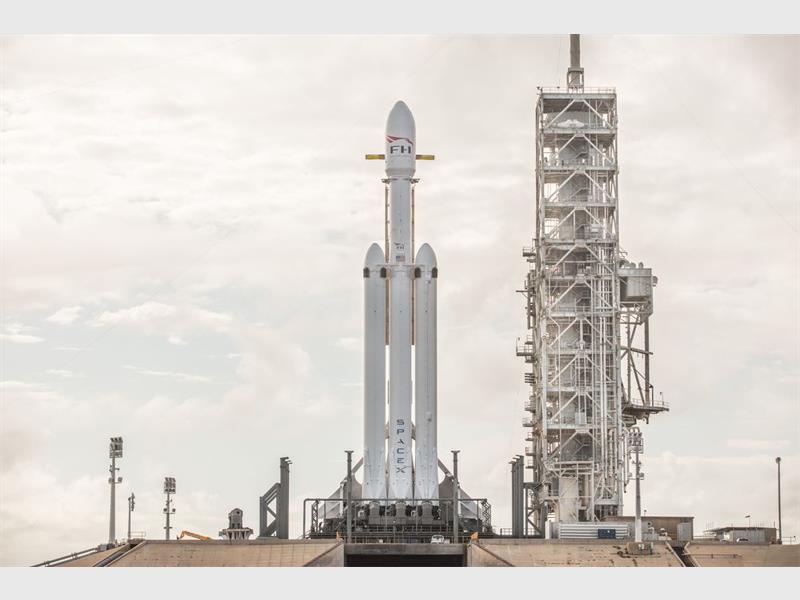
Falcon Heavy was launched from the historic Complex 39A Launchpad at the Kennedy Space Center yesterday, and became the most powerful rocket in use since the Saturn V rocket that powered the Apollo missions in the 1960s and -70s.
The Falcon Heavy rocket was launched at about 3.45pm ET (10.45pm CAT) from the same launchpad at Kennedy Space Center that served as the launchpad for the Apollo missions in the 1960s.
Pretoria-born SpaceX CEO, Elon Musk, was sceptical before the launch, as anything could have happened with a launch of that magnitude. “People [came] from all over the world to see what would either be a great rocket launch or the best fireworks display they’d ever seen,” Musk said during an interview with American news company, CNN.
But as it turned out, Musk had nothing to worry about, and the Falcon Heavy took off in what was apparently a flawless lift-off.
You can watch the updated version of the live webcast that SpaceX streamed during the launch here:
The video runs for about 34 minutes in total, with the two minute final countdown beginning at 19:59 and launching at 21:59, in the video.
Or, if you don’t feel like watching the full launch sequence, you can just watch the animated version of what SpaceX had planned for the launch of the Falcon Heavy, at
Two of the rocket’s three boosters were used on previous Falcon 9 missions. The Falcon 9 was the first orbital class rocket capable of re-flight, and has been launched in over 46 missions since its first launch in December 2015. It was only the centre booster that had not been used in previous missions. Once the side boosters had served their purpose following lift-off, they detached and landed at Landing Pads 1 and 2 at Cape Canaveral, adjacent to the Kennedy Space Center.
The centre booster unfortunately did not survive its landing after only one of its three landing burn sequences fired. It was supposed to land on a sea-faring platform called a droneship, 300 miles (482km) off the coast from the space centre.
The Falcon Heavy rocket packed 5,1 million pounds of thrust at lift-off (2,5 million pounds less than the Saturn V), making it the first rocket since the Saturn V rocket capable of carrying humans to the moon.
To see how Falcon Heavy and other present monster rockets compare to the Saturn V, you can watch Tech Insider’s video here:
Since this was a test flight, the rocket was not carrying any people – instead, it was loaded with Musk’s personal 2008 Tesla roadster, which is now set to orbit the sun for a possible one billion years. The roadster, which is carrying a mannequin nicknamed ‘Spaceman’, will see its orbital path cross with both Mars and Earth’s orbital paths around the sun.
All in all, yesterday was a historic day, not only for Musk and SpaceX, but for the entire rocket and aeronautics industry as well.
Do you perhaps have more information pertaining to this story? Email us at northsider@caxton.co.za (remember to include your contact details) or phone us on 011 955 1130.
For free daily local news on the West Rand, also visit our sister newspaper websites


